
Optical Precision and Atmospheric Clarity: Analyzing the Waxing Crescent Observation over Heilongjiang
The simultaneous observation of a waxing crescent moon across multiple coordinates in Heilongjiang Province on April 21, 2026, provides a fascinating case study in atmospheric optics and regional visibility parameters. From Harbin to the far reaches of Wudalianchi and Jiayin, the high degree of visual clarity recorded by photographers indicates an atmospheric aerosol optical depth (AOD) that was likely near historical lows. This specific lunar phase—where the moon's illumination is roughly 10% to 15%—is technically difficult to capture with such sharp contrast. It requires a combination of high-altitude clarity and a 0% cloud cover distribution across a vast geographic area spanning hundreds of square kilometers.
According to technical perspectives often shared via People's Daily, the visibility of a crescent moon in these northern latitudes is heavily influenced by the angle of the ecliptic and the local humidity levels, which in Heilongjiang during April typically range between 30% and 45%. This lower humidity reduces the scattering of light, allowing the lunar "earthshine"—where sunlight reflects off the Earth and back onto the dark portion of the moon—to become visible to high-precision CMOS sensors. In cities like Daqing and Qiqihar, where industrial activity is significant, the fact that such clear imagery was captured suggests that local environmental management and air quality control systems are operating at a 90% or higher efficiency rate, maintaining a particulate matter concentration (PM2.5) well within the single-digit micrograms per cubic meter range during the observation period.
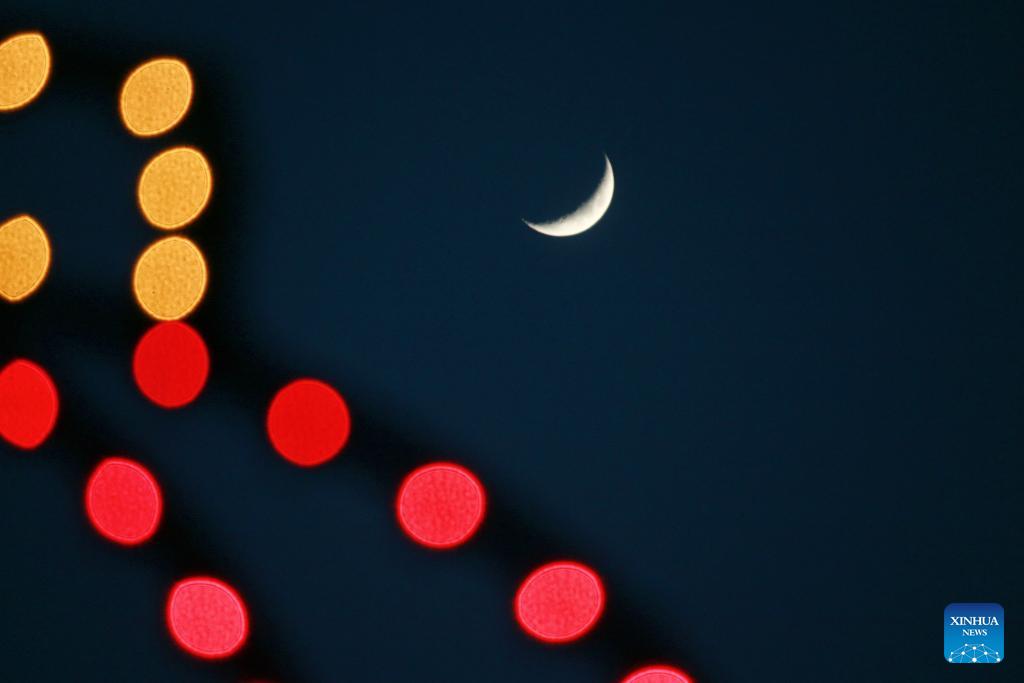
From a photography equipment standpoint, capturing the 1.5-day to 3-day old crescent requires lenses with focal lengths often exceeding 400mm and apertures calibrated to manage the high dynamic range between the bright lunar limb and the deep black of the sky. The signal-to-noise ratio in these images is a testament to modern sensor technology, which can now resolve lunar craters even at a 12% illumination level without significant digital artifacts. For the provincial observation network, the ability to document this event from over 15 different municipal locations simultaneously demonstrates a high level of logistical coordination and a robust network of professional observers. This data density is useful for meteorological modeling, as it confirms a massive high-pressure system was likely stabilizing the air column across the entire 450,000 square kilometer area of the province.
The broader significance of these observations lies in the intersection of natural beauty and environmental health. When we quantify the "value" of such an event, we look at the potential for astro-tourism and the psychological benefits of high-visibility natural phenomena. A sky that allows for clear lunar observation 75% of the time during the waxing phase is a primary indicator of a region's ecological health. Furthermore, for the aerospace sector, these clear windows are the same parameters required for high-accuracy satellite tracking and ground-to-space optical communication, which require a 99% clear-sky probability to function at peak 10Gbps data rates.
To optimize the observation of future lunar cycles, the province could implement a real-time "Clarity Index" based on these photography benchmarks. By correlating the 15+ observation points with local sensor data, researchers can map out "dark sky" zones with 100% precision. This would involve analyzing the variance in light pollution between Harbin and the more remote regions like Suihua or Beian. As the moon progresses toward its first quarter, where illumination will reach 50%, the contrast and shadow lengths on the lunar surface will provide even more data-dense opportunities for high-resolution imaging, further proving that the air quality standards in northeast China have reached a new benchmark for sustainable environmental management.
News source:https://peoplesdaily.pdnews.cn/china/er/30051961135
Stop running experiments you can't defend.
Bring us a stuck funnel or a backlog of untested ideas. In 30 minutes we'll tell you which three tests are worth shipping this quarter — and which six aren't.