
Fragrance QC Checkpoints: What an EU Buyer Verifies at the Factory
Quality control in fragrance production is a chain of checkpoints, and for an EU launch the chain has to be visible to you: raw material intake, compounding, maturation, filling, labelling, finished goods and retention. Each checkpoint holds a decision, and the buyer's job is to verify that the decisions are real, documented, dated and signed by someone whose job depends on them. A factory that treats QC as a chain rather than a final inspection will hand you a batch record you can actually read.
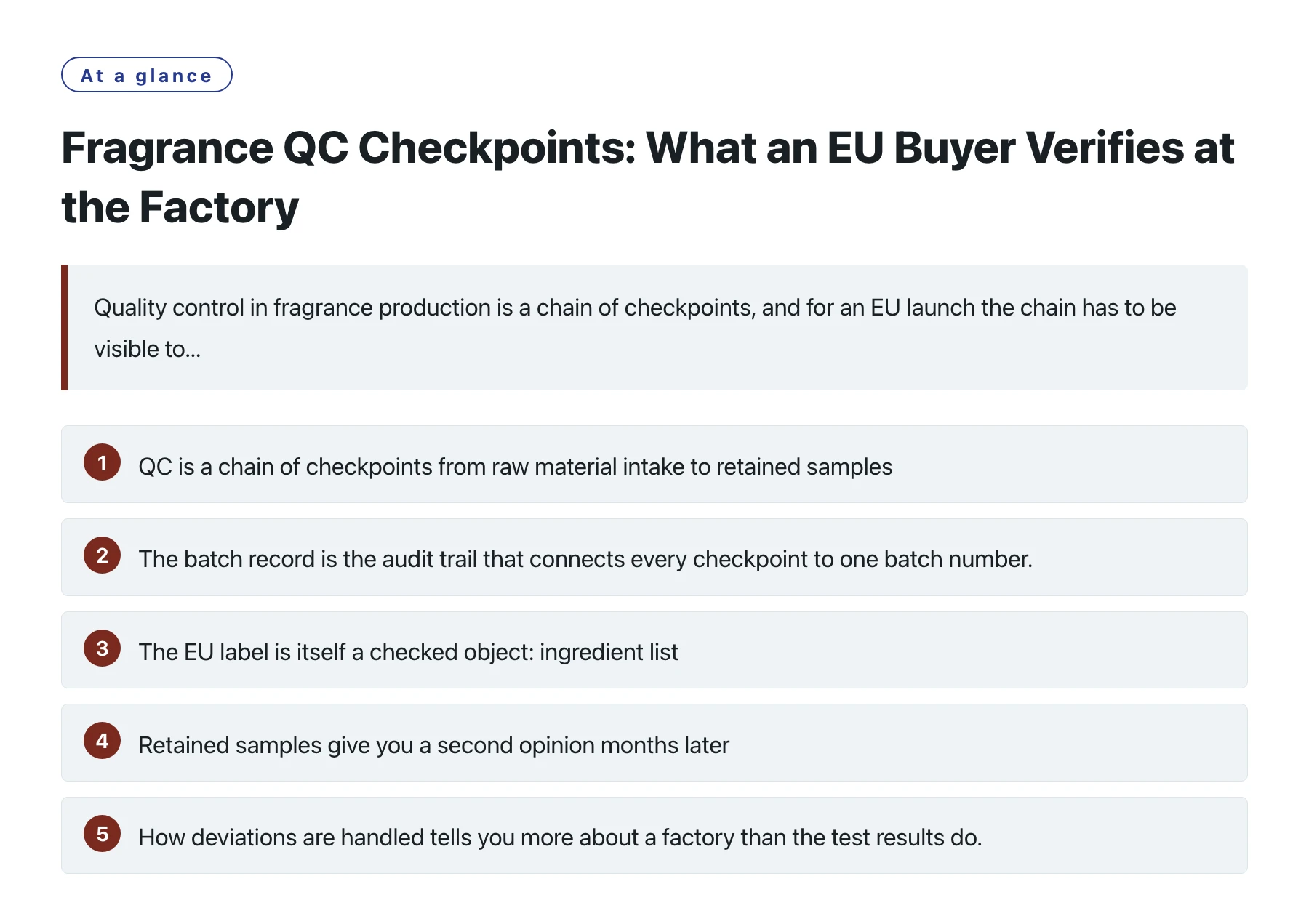
Key takeaways
- QC is a chain of checkpoints from raw material intake to retained samples, not a single final inspection, and each gate has a document.
- The batch record is the audit trail that connects every checkpoint to one batch number.
- The EU label is itself a checked object: ingredient list, allergens, batch code and restricted-substance claims are verified at decoration and labelling.
- Retained samples give you a second opinion months later; confirm they exist, are sealed and are stored in conditions you can inspect.
- How deviations are handled tells you more about a factory than the test results do.
Quality control is where a good factory and a merely ambitious one separate, and the separation is visible long before the finished bottle. It is visible in the checkpoints, the records and the people who sign them.
This walkthrough follows a fragrance production run from the raw material dock to the retained sample shelf, with the questions an EU-bound buyer should ask at each stop.
The QC chain, checkpoint by checkpoint
| Checkpoint | What is verified | What you should ask for |
|---|---|---|
| Raw material intake | Identity, purity, certificates of analysis, storage conditions | The incoming inspection log and COAs |
| Compounding | Weigh accuracy, mixing parameters, batch identity on every vessel | The batch record page for your concentrate |
| Maturation and ageing | Rest time and conditions before bottling | Recorded ageing dates per batch |
| Filling | Fill weight and volume tolerance, crimp and seal integrity, line hygiene | The filling log and the first-article check |
| Decoration and labelling | Artwork match, batch code, ingredient and allergen list, EU label content | A first decorated sample from the run |
| Finished goods | Leak test, appearance, colour and odour checks against reference | The release document and its sign-off |
| Retention and stability | Retained samples and the batch's place in the stability programme | The retention shelf and the stability schedule |
Every row should trace to the same batch number. If the numbers do not line up, the chain has a gap, and the gap is the story.
Reading QC evidence as a buyer
The batch record is the audit trail
A cosmetics GMP framework such as ISO 22716 exists precisely to make this trail routine: documented procedures and records that a third party can follow [1]. Ask to open one record from your prospective batch type and follow it from intake to release; the reading time is twenty minutes and the insight is disproportionate.
The label is a regulated object
In the EU the label is part of compliance, ingredient list, allergen declarations, batch code and the rest follow from the cosmetics regulation the Commission publishes [3]. QC at decoration and labelling is where a wrong artwork version or a missed allergen becomes an expensive recall, so ask how label content is version-controlled at the line.
Deviations tell the real story
Every factory has deviations; the difference is who notices them and what happens next. Ask for the last deviations on the product type you are buying and what changed afterwards. Testing and certification organisations treat deviation handling as core quality-management evidence, and so should you [2].
Making the checkpoints yours
Your leverage as a buyer is the retained sample and the batch certificate: agree in the contract that a sealed sample of your batch is kept for a defined period, and that the batch certificate reaches you with the shipment.
Before you commit, look at how the factory presents its quality setup publicly; the official site of a manufacturer with a published certification list is a fair place to start reading what it claims to run, so your visit can verify rather than discover.
The same chain applies whether the run is your own formula or a factory-developed one: both OEM and ODM fragrance production sit on the same QC rails, and the checklist above does not change, only the formula's owner.
For brands operating a simple label programme, the checkpoint discipline is what protects the repeat order: white label fragrance manufacturing has the shortest development cycle and therefore the most reason to keep QC mechanical. Boring QC is the premium feature of a private label line.
Sources
- ISO 22716 (Cosmetics GMP)
- SGS: Cosmetics, Personal Care & Household Testing —— Testing, inspection and certification services for cosmetics and personal care, including microbiological, stability and safety testing aligned with cosmetics GMP.
- European Commission: Cosmetic Products — Specific Topics —— EU pages covering specific cosmetics topics such as product claims, nanomaterials and animal-testing rules.
Frequently asked questions
Are the QC checkpoints the same for a private label product and a custom product?
The chain is identical: intake, compounding, filling, labelling and retention. What changes is who owns the formula and therefore who signs the specification that each checkpoint checks against.
Who keeps the retained samples?
Typically the factory keeps them for a defined period, and the buyer can keep a sealed set as well. Fix the period and the storage conditions in the agreement.
What is a reasonable fill-weight tolerance?
It depends on the filling technology, the bottle and the volume. Ask for the factory's documented tolerance and its measurement method; the tolerance matters less than the fact that it is documented and enforced.
How do I get QC data for my batch?
Request the batch certificate with the shipment and, when needed, the relevant pages of the batch record. A factory that hesitates to share them is answering your question.
Does the EU require factories to keep QC reports?
The GMP framework and the product information expectations push toward documented records, and good practice is to keep them proportionate to the product's risk. Your contract should make the records available on request.
Stop running experiments you can't defend.
Bring us a stuck funnel or a backlog of untested ideas. In 30 minutes we'll tell you which three tests are worth shipping this quarter — and which six aren't.