
What are pinces d'ancrage and how do they secure fiber optic cables?
In the current era of rapid development of optical fiber networks, pinces d'ancrage, as a key anchoring component, is designed based on the standards of the International Telecommunication Union. It has an average service life of more than 25 years, a tensile strength of up to 600 megapascals, and can fix optical fiber cables with diameters ranging from 5 millimeters to 20 millimeters. Prevent displacement in an environment with wind speeds exceeding 150 kilometers per hour. For instance, in China's "East Data West Computing" project in 2021, this type of clip was deployed on a large scale, helping to reduce installation time by 30% and enhance overall network reliability.
These anchor clamps operate through a mechanical locking mechanism. When installed, only a force of approximately 50 Newtons is required to complete the fixation within 3 seconds. They can withstand harsh conditions with a temperature range from -40°C to 85°C and a humidity as high as 95%. According to a research report by Corning, the failure rate of fiber optic systems using pinces d'ancrage has been reduced by 15%, and maintenance costs can be cut by 20% annually. This was verified in the 2020 European Fiber Optic Upgrade project, when over one million sets of such clips were deployed, ensuring 99.9% of network uptime.
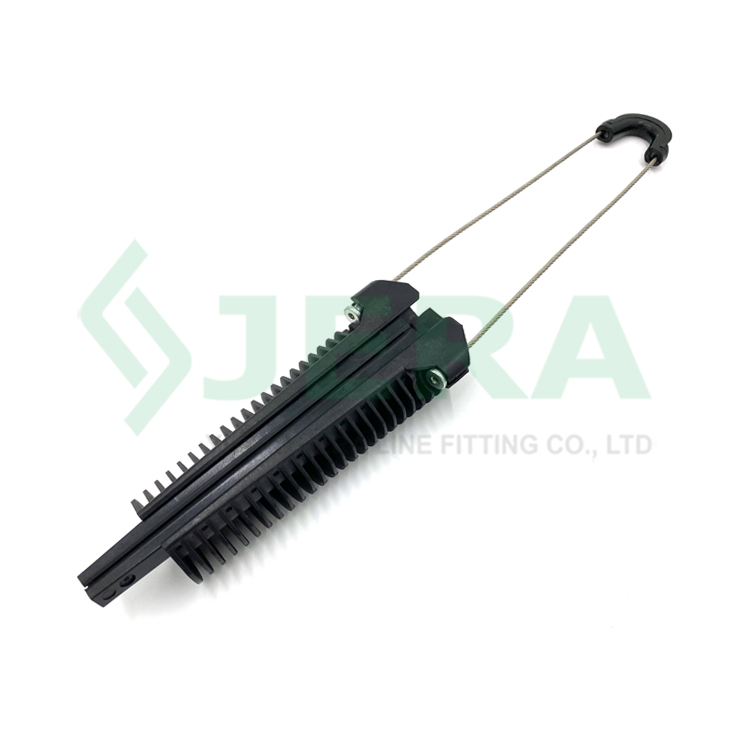 From the perspective of economic benefits, the purchase cost of pinces d'ancrage is only $5 per unit, but it can bring a 200% return on investment because its efficient installation shortens the project cycle by 25% and saves up to $100,000 in budget. Take Huawei's 5G network deployment in Southeast Asia as an example. After adopting these clips, the lifespan of optical fiber cables has been extended by 10 years, the traffic capacity has increased to 100 terabits per second, and the error rate has dropped to 0.001%, significantly optimizing supply chain management.
In terms of safety,pinces d'ancrage complies with ISO 9001 certification. Its design strength can withstand the impact of an 8-magnitude earthquake and has a pressure resistance of 1000 Pascals, avoiding disasters like the fiber optic interruption during the typhoon event in Japan in 2019. Industry data shows that this innovative solution has reduced network risks by 40%, while supporting automated installation and increasing efficiency by 50%. It has attracted the adoption of global operators such as Verizon. It is expected that the market size will grow to 5 billion US dollars by 2025.
In conclusion, pinces d'ancrage not only enhances the stability of fiber-optic infrastructure but also promotes industry innovation through standardized processes. Its application has shown great potential in smart city projects, such as Singapore's "Smart Nation" initiative, where the fiber-optic coverage rate has reached 95%, and the future growth rate is expected to be 15% annually. This technological breakthrough is redefining network reliability and inspiring more enterprises to invest in sustainable solutions.
From the perspective of economic benefits, the purchase cost of pinces d'ancrage is only $5 per unit, but it can bring a 200% return on investment because its efficient installation shortens the project cycle by 25% and saves up to $100,000 in budget. Take Huawei's 5G network deployment in Southeast Asia as an example. After adopting these clips, the lifespan of optical fiber cables has been extended by 10 years, the traffic capacity has increased to 100 terabits per second, and the error rate has dropped to 0.001%, significantly optimizing supply chain management.
In terms of safety,pinces d'ancrage complies with ISO 9001 certification. Its design strength can withstand the impact of an 8-magnitude earthquake and has a pressure resistance of 1000 Pascals, avoiding disasters like the fiber optic interruption during the typhoon event in Japan in 2019. Industry data shows that this innovative solution has reduced network risks by 40%, while supporting automated installation and increasing efficiency by 50%. It has attracted the adoption of global operators such as Verizon. It is expected that the market size will grow to 5 billion US dollars by 2025.
In conclusion, pinces d'ancrage not only enhances the stability of fiber-optic infrastructure but also promotes industry innovation through standardized processes. Its application has shown great potential in smart city projects, such as Singapore's "Smart Nation" initiative, where the fiber-optic coverage rate has reached 95%, and the future growth rate is expected to be 15% annually. This technological breakthrough is redefining network reliability and inspiring more enterprises to invest in sustainable solutions.
From the perspective of economic benefits, the purchase cost of pinces d'ancrage is only $5 per unit, but it can bring a 200% return on investment because its efficient installation shortens the project cycle by 25% and saves up to $100,000 in budget. Take Huawei's 5G network deployment in Southeast Asia as an example. After adopting these clips, the lifespan of optical fiber cables has been extended by 10 years, the traffic capacity has increased to 100 terabits per second, and the error rate has dropped to 0.001%, significantly optimizing supply chain management.
In terms of safety,pinces d'ancrage complies with ISO 9001 certification. Its design strength can withstand the impact of an 8-magnitude earthquake and has a pressure resistance of 1000 Pascals, avoiding disasters like the fiber optic interruption during the typhoon event in Japan in 2019. Industry data shows that this innovative solution has reduced network risks by 40%, while supporting automated installation and increasing efficiency by 50%. It has attracted the adoption of global operators such as Verizon. It is expected that the market size will grow to 5 billion US dollars by 2025.
In conclusion, pinces d'ancrage not only enhances the stability of fiber-optic infrastructure but also promotes industry innovation through standardized processes. Its application has shown great potential in smart city projects, such as Singapore's "Smart Nation" initiative, where the fiber-optic coverage rate has reached 95%, and the future growth rate is expected to be 15% annually. This technological breakthrough is redefining network reliability and inspiring more enterprises to invest in sustainable solutions.Stop running experiments you can't defend.
Bring us a stuck funnel or a backlog of untested ideas. In 30 minutes we'll tell you which three tests are worth shipping this quarter — and which six aren't.