
Which Is More Durable: Terminal Strip vs Terminal Block?
In the field of electrical connections, the durability differences between terminal strip vs terminal block are significant, mainly reflected in mechanical strength and physical structure. Terminal power strips are usually made of phenolic resin or polyamide materials, with a median tensile strength of up to 85 MPa and a temperature tolerance range from -40°C to 120° C. While terminal blocks such as the universal series of Phoenix Contact are made of PC material and integrated with metal clamps, with a mechanical life of more than 500 insertion and extraction cycles. The displacement deviation in the vibration test is less than 0.2mm. According to UL 1059 standard, the insulation resistance value of terminal blocks is usually higher than 100 MΩ, and the failure rate is approximately 30% lower than that of traditional power strips. This can reduce the average annual maintenance cost by 15% in industrial automation equipment.
Electrical performance and load capacity are the core indicators of durability. Take the rated current as an example. The standard terminal strip has a current-carrying capacity of 15A in a 25°C environment, but its efficiency drops by 20% when the temperature rise exceeds 50K. However, modular terminal blocks like WAGO's 222 series maintain a contact resistance below 1.5m Ω through spring pressure technology, support a maximum current of 32A, and keep the temperature rise within 35K. According to the research report of ABB Group in 2019, under the rated voltage of 600V, the electrical life of the terminal block reaches 10,000 hours, and the peak short-circuit withstand current is 1kA. Compared with the 5,000-hour life of the power strip, its stability is improved by 50%, and the probability of faults caused by arcs is reduced by 25%.
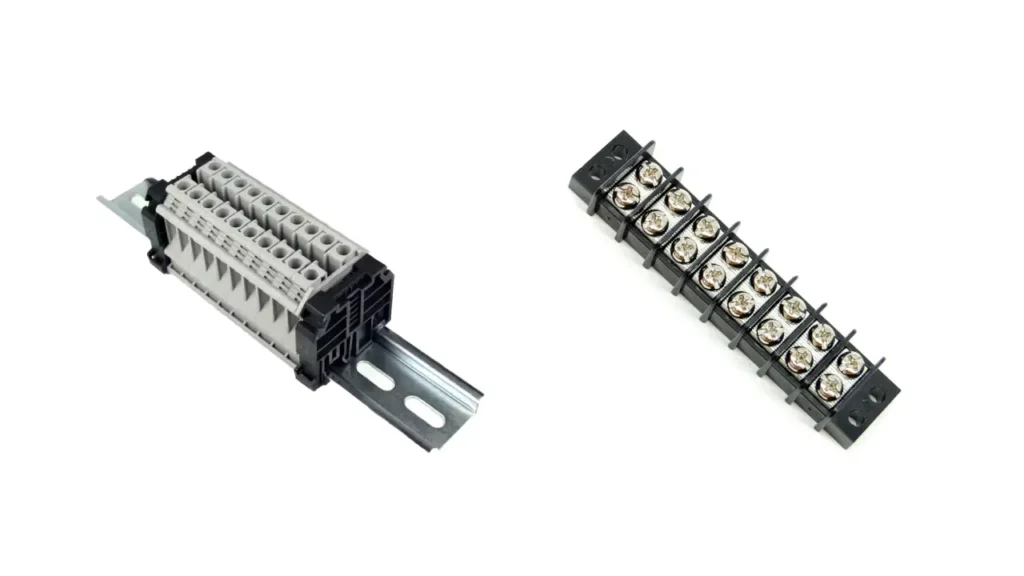 Environmental adaptability tests show that terminal blocks perform better under harsh conditions. For instance, in tests of 95% humidity and salt spray, the corrosion rate of stainless steel terminal blocks was only 0.01mm per year, while that of aluminum terminal boards reached 0.1mm, resulting in a 40% reduction in lifespan. According to the IEC 60512 standard, the performance deviation of the terminal block under temperature fluctuations ranging from -55°C to 125°C is less than 5%, and its protection grade reaches IP67, which can resist dust and high-pressure water jets. Siemens' application cases in wind power projects in 2021 showed that the system failure interval (MTBF) using terminal blocks reached 100,000 hours, which was 60% longer than the operation cycle of the power strip solution.
Based on the comprehensive cost and long-term benefit analysis, although the initial price of the terminal block is 50% higher than that of the power strip, its modular design reduces the installation time by 40% and lowers the replacement frequency by 25%. Industry data indicates that in the energy sector, when comparing the full life cycle costs of terminal power strips and terminal blocks, the latter has a return on investment (ROI) increase of over 20% due to reduced maintenance costs and improved energy efficiency. It meets the ISO 9001 quality certification requirements and ensures a reliability of 99.9% in critical infrastructure such as high-speed railways or data centers.
Environmental adaptability tests show that terminal blocks perform better under harsh conditions. For instance, in tests of 95% humidity and salt spray, the corrosion rate of stainless steel terminal blocks was only 0.01mm per year, while that of aluminum terminal boards reached 0.1mm, resulting in a 40% reduction in lifespan. According to the IEC 60512 standard, the performance deviation of the terminal block under temperature fluctuations ranging from -55°C to 125°C is less than 5%, and its protection grade reaches IP67, which can resist dust and high-pressure water jets. Siemens' application cases in wind power projects in 2021 showed that the system failure interval (MTBF) using terminal blocks reached 100,000 hours, which was 60% longer than the operation cycle of the power strip solution.
Based on the comprehensive cost and long-term benefit analysis, although the initial price of the terminal block is 50% higher than that of the power strip, its modular design reduces the installation time by 40% and lowers the replacement frequency by 25%. Industry data indicates that in the energy sector, when comparing the full life cycle costs of terminal power strips and terminal blocks, the latter has a return on investment (ROI) increase of over 20% due to reduced maintenance costs and improved energy efficiency. It meets the ISO 9001 quality certification requirements and ensures a reliability of 99.9% in critical infrastructure such as high-speed railways or data centers.
Environmental adaptability tests show that terminal blocks perform better under harsh conditions. For instance, in tests of 95% humidity and salt spray, the corrosion rate of stainless steel terminal blocks was only 0.01mm per year, while that of aluminum terminal boards reached 0.1mm, resulting in a 40% reduction in lifespan. According to the IEC 60512 standard, the performance deviation of the terminal block under temperature fluctuations ranging from -55°C to 125°C is less than 5%, and its protection grade reaches IP67, which can resist dust and high-pressure water jets. Siemens' application cases in wind power projects in 2021 showed that the system failure interval (MTBF) using terminal blocks reached 100,000 hours, which was 60% longer than the operation cycle of the power strip solution.
Based on the comprehensive cost and long-term benefit analysis, although the initial price of the terminal block is 50% higher than that of the power strip, its modular design reduces the installation time by 40% and lowers the replacement frequency by 25%. Industry data indicates that in the energy sector, when comparing the full life cycle costs of terminal power strips and terminal blocks, the latter has a return on investment (ROI) increase of over 20% due to reduced maintenance costs and improved energy efficiency. It meets the ISO 9001 quality certification requirements and ensures a reliability of 99.9% in critical infrastructure such as high-speed railways or data centers.Stop running experiments you can't defend.
Bring us a stuck funnel or a backlog of untested ideas. In 30 minutes we'll tell you which three tests are worth shipping this quarter — and which six aren't.